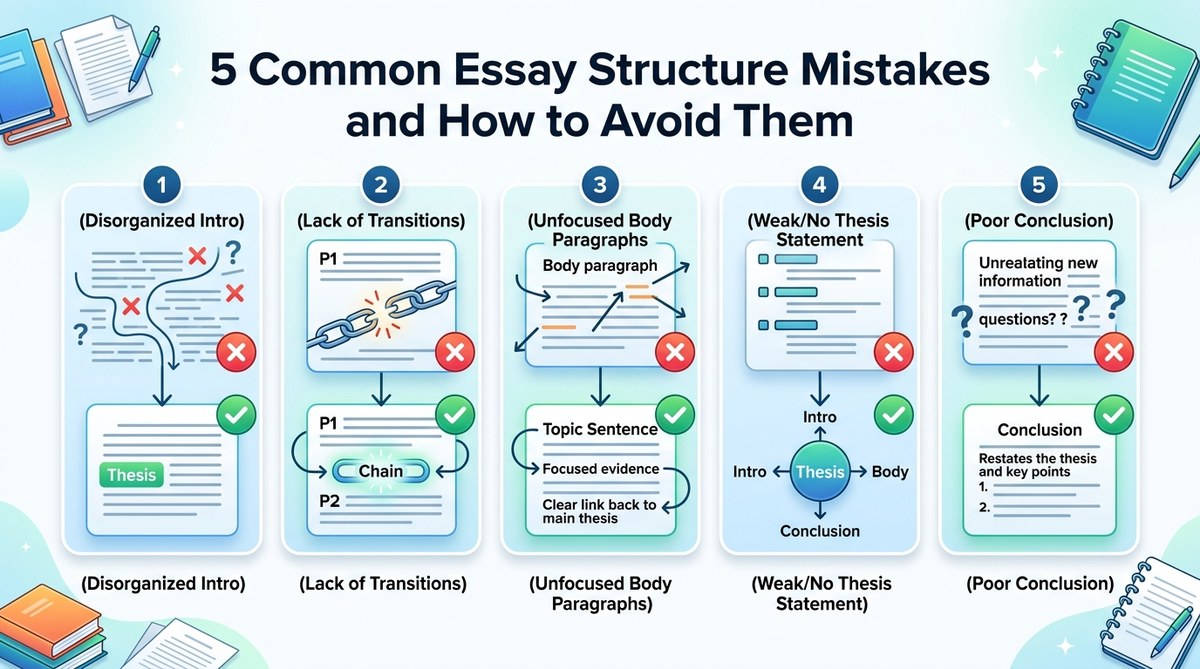
5 Common Essay Structure Mistakes and How to Avoid Them
If you’ve ever turned in an essay and felt something was off, you’re not alone. Many students struggle with structure without realizing it. Simple mistakes can pull down a grade, but the good news is they are easy to fix. Recognizing these common essay mistakes is the first step toward writing better papers. Below, we break down five frequent structure problems and give you clear solutions.
The five most common essay mistakes are weak thesis statements, missing topic sentences, poor paragraph unity, weak transitions, and flat conclusions. Each one can be fixed with a specific technique. By applying the tips in this guide, you will immediately improve your essay structure and earn higher marks. Practice each fix until it becomes a habit.
Mistake 1: A Weak or Missing Thesis Statement
Your thesis sentence is the heart of your essay. It tells the reader what your main argument is and how you will support it. Many students write a thesis that is too vague or just restates the prompt.
Example of a weak thesis: “Social media has good and bad effects on teenagers.”
That sentence is too broad. It does not give a clear position or preview the points.
Fix: Make your thesis specific and arguable. Include a hint of your supporting points.
Improved thesis: “Social media harms teenagers by reducing face-to-face interaction, increasing anxiety, and promoting unrealistic body standards.”
This version is direct, debatable, and outlines the essay’s structure.
To strengthen your thesis further, check out this guide on 5 research-backed techniques to strengthen your essay thesis in 2026.
How to Write a Strong Thesis in Three Steps
- Identify your topic and your stance.
- List two to three main reasons for your stance.
- Combine them into one sentence that is clear and specific.
Signs Your Thesis Needs Work
- It uses words like “good,” “bad,” “interesting,” or “important” without explanation.
- A reader could argue both sides with equal evidence.
- You cannot find a counterargument because the thesis is so vague.
Mistake 2: Missing or Weak Topic Sentences
Every body paragraph should start with a topic sentence that tells the reader what that paragraph is about. Without it, your writing feels scattered. Readers get lost.
Example of a missing topic sentence: “Many studies show that sleep deprivation affects memory. In one experiment, students who slept less than six hours scored twenty percent lower on recall tests. Also, lack of sleep reduces attention span.”
The paragraph jumps between memory and attention without a clear focus.
Fix: Write a topic sentence that introduces the main idea of the paragraph and connects to your thesis.
Improved: “One major effect of sleep deprivation is impaired memory retention.” Then follow with evidence and explanation. The next paragraph can begin with “Sleep loss also reduces attention span.”
A clear topic sentence acts like a mini thesis for each paragraph.
Mistake 3: Poor Paragraph Unity
A paragraph should cover one main idea. Many students mix unrelated points in the same paragraph. This confuses the reader and weakens the argument.
Example of poor unity: “Regular exercise improves heart health. It also helps with weight management. The government should fund more public parks because outdoor activities encourage fitness. Additionally, walking in nature reduces stress.”
The last two sentences shift from individual health benefits to a policy recommendation and then to stress reduction. They belong in separate paragraphs.
Fix: Before writing each paragraph, decide on one central claim. Delete or move any sentence that does not support that claim.
Checklist for Paragraph Unity
- Does every sentence support the topic sentence?
- If a sentence could fit in a different paragraph, move it there.
- Do not overload a paragraph with multiple ideas.
For more on structuring solid paragraphs, see essential tips for writing clear and impactful academic essays.
Mistake 4: Weak Transitions Between Paragraphs
Transitions guide your reader from one point to the next. Without them, your essay feels choppy and disjointed. Many students jump directly from one paragraph to another without any connecting phrase or logic.
Example of missing transition: (End of paragraph) “Reducing screen time improves sleep quality.” (Start of next paragraph) “Healthy eating habits also contribute to better rest.” The reader is left wondering how the two ideas relate.
Fix: Use transition words or phrases that show the relationship between paragraphs. Common relationships include addition, contrast, cause and effect, or sequence.
Improved: “In addition to reducing screen time, adopting healthy eating habits can further enhance sleep quality.” Or “While screen time reduction helps, diet plays an equally important role in sleep regulation.”
Table: Transition Types and Examples
| Relationship | Transition Phrase | Example Use |
|---|---|---|
| Addition | Furthermore, Moreover, Additionally | “Furthermore, exercise boosts mental health.” |
| Contrast | However, On the other hand, Nevertheless | “However, the study found no effect on adults.” |
| Cause/Effect | Therefore, As a result, Consequently | “Therefore, schools should implement later start times.” |
| Sequence | First, Second, Next, Finally | “First, identify the problem. Then, propose a solution.” |
For a deeper look at connecting ideas, read how to use transitions to improve essay flow and clarity.
Expert Tip: Always read your essay aloud. If you sound like you are jumping from one thought to another, you need a better transition. A smooth essay lets the reader glide from point to point.
Mistake 5: Flat or Repetitive Conclusions
Many students end their essays by simply restating the thesis or adding a short “In conclusion” followed by the same points again. A conclusion should leave the reader with a sense of closure and a final thought.
Example of a flat conclusion: “In conclusion, social media has both good and bad effects. It helps people connect but also causes anxiety. That’s why we need to be careful.”
That summary adds nothing new.
Fix: Restate your thesis in fresh words, summarize your main points briefly, and then offer a broader implication or call to action.
Improved conclusion: “Social media is not inherently good or bad; its impact depends on how we use it. By setting screen time limits and choosing positive communities, we can reduce anxiety and foster genuine connections. The next time you open an app, ask yourself: Is this enriching my life or draining it?”
A strong conclusion answers the “so what” question. It shows why your argument matters beyond the essay itself.
To master the art of ending an essay, check out why your essay conclusions are losing you points (and what to do instead).
Common Conclusion Pitfalls
- Using “In conclusion” or “To summarize” as a crutch. (Instead, use a fresh transition like “Ultimately” or “Looking ahead.”)
- Introducing a completely new idea at the end.
- Copying your thesis word for word.
- Ending abruptly without a final thought.
Putting It All Together: A Practice Routine
Now that you know the five common essay mistakes, practice them one at a time. Choose an old essay or a draft and review it for each issue:
- Underline your thesis. Is it specific and arguable?
- Check each paragraph’s first sentence. Does it clearly state the main idea?
- Remove any unrelated sentences from each paragraph.
- Add transitions between paragraphs where they are missing.
- Rewrite your conclusion to include a broader implication.
Repeat this process for your next two essays. With practice, you will stop making these common essay mistakes and see your grades improve.
Your Turn: Start Fixing Your Essays Today
You now have a clear roadmap. The mistakes outlined here are the most common essay errors that hold students back. But knowing them is only half the battle. You must apply the fixes every time you write.
Set aside fifteen minutes after finishing an essay to check for weak thesis statements, missing topic sentences, poor unity, weak transitions, and flat conclusions. That small habit will transform your writing. Over time, these corrections will become second nature.
Start with your next assignment. Pick one mistake to focus on and use the specific fix from this guide. Watch how your essay feels more organized and your instructor’s feedback changes. You have the tools. Now go write something great.